
Search Engine Optimization (SEO) has changed dramatically over the last few years. Ranking on Google is no longer just about stuffing keywords into articles or building hundreds of backlinks. Modern SEO requires data-driven decisions, technical optimization, competitor research, search intent analysis, and content that genuinely helps users.
Whether you’re a blogger, affiliate marketer, digital marketing agency, ecommerce business owner, YouTuber, or SEO professional, having access to the best SEO tools in 2026 can significantly improve your workflow and help you make smarter marketing decisions.
Today’s SEO platforms do much more than find keywords. They analyze competitors, uncover backlink opportunities, monitor rankings, perform technical audits, discover trending content, optimize product pages, and even use artificial intelligence to suggest content improvements.
However, choosing the right tool isn’t easy. There are hundreds of SEO platforms available, each specializing in different areas. Some focus on keyword research, while others excel at technical SEO, backlink analysis, ecommerce optimization, YouTube SEO, or content planning.
That’s why we’ve created this comprehensive guide covering the best SEO tools available in 2026. Instead of simply listing popular software, we’ll explain what each platform does best, who should use it, its strengths, limitations, and where it fits into an effective SEO strategy.
Whether you’re searching for the best free SEO analysis tools, looking for tools for digital marketers and SEO copywriters, exploring free tools for YouTube SEO, or trying to find the best tools for SEO ecommerce, this guide has you covered.
Google processes billions of searches every day, and competition for the first page continues to increase. At the same time, search engines have become significantly better at understanding user intent, content quality, and website authority.
A successful SEO strategy today involves much more than writing blog posts. Marketers now rely on specialized tools to:
Trying to perform these tasks manually isn’t just time-consuming—it often leads to missed opportunities and inaccurate decisions. The right SEO software can automate repetitive tasks, provide actionable insights, and help prioritize efforts that drive measurable results.
Not every SEO platform is designed for the same audience. Some are built for enterprise agencies, while others are ideal for bloggers or small businesses. Before investing in any tool, it’s important to understand the features that actually matter
Keyword research remains the foundation of every SEO strategy. The best SEO tools help identify search terms that balance traffic potential with realistic ranking difficulty. They also uncover long-tail keywords, related questions, and search intent, allowing you to create content that matches what users are actually looking for.
Understanding what competitors are doing can save countless hours of trial and error. Leading platforms reveal which keywords competitors rank for, which pages generate the most traffic, and where their backlinks come from. These insights help you identify gaps and opportunities in your own strategy.
Even the best content can struggle if a website has technical issues. Comprehensive SEO tools scan websites for broken links, duplicate content, missing meta tags, crawl errors, slow-loading pages, and mobile usability problems. Fixing these issues improves both search engine visibility and user experience.
Backlinks remain one of Google’s strongest ranking signals. Quality SEO software helps monitor backlink profiles, evaluate referring domains, and identify new link-building opportunities while avoiding potentially harmful links.
Monitoring keyword rankings over time allows marketers to measure the effectiveness of SEO campaigns. Reliable tools provide daily or weekly ranking updates, helping users identify trends and react quickly to algorithm changes.
Modern SEO platforms increasingly include AI-powered content optimization features. These tools analyze top-ranking pages, recommend semantic keywords, suggest heading structures, and identify content gaps to improve topical relevance.
For agencies and marketing teams, customizable reports and automated workflows are invaluable. They simplify client reporting and reduce manual work, allowing professionals to focus on strategy rather than repetitive tasks.
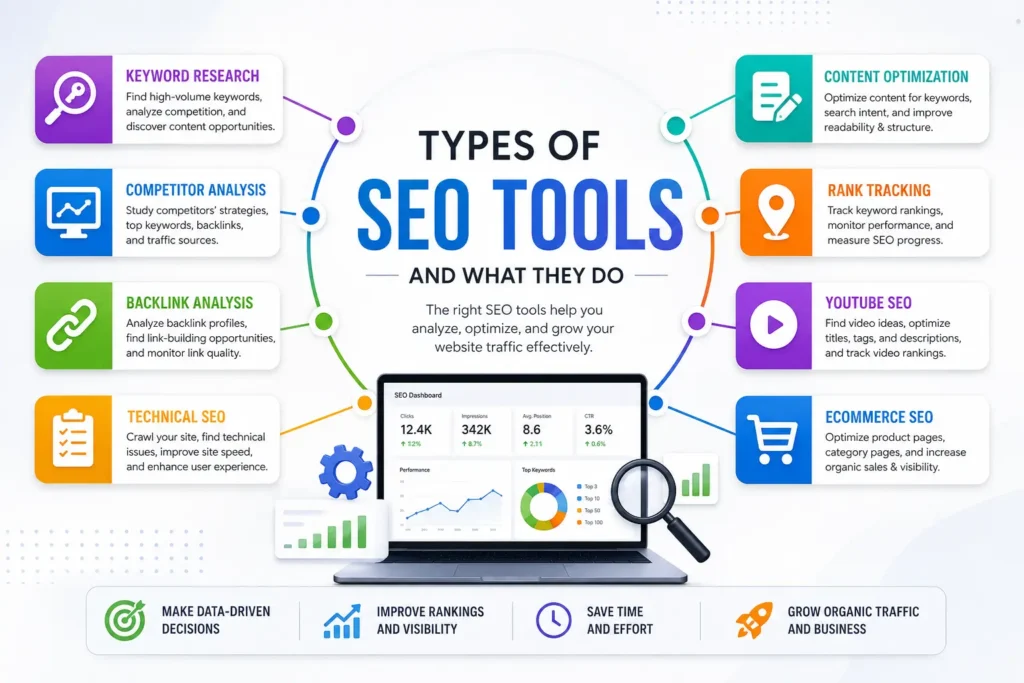
Not all SEO tools serve the same purpose. Understanding the different categories can help you build a toolkit that matches your specific goals.
These platforms help discover keywords, estimate search volume, analyze competition, and uncover long-tail opportunities. Examples include Semrush, KWFinder, KeywordTool, and Ubersuggest.
Technical SEO platforms focus on website health by identifying crawl errors, broken links, duplicate content, indexing issues, and page performance. Seobility, SEO Site Checkup, and Screpy are strong options in this category.
Backlink-focused software evaluates referring domains, anchor text, and overall link quality. Majestic and Moz Pro are widely recognized for their backlink analysis capabilities.
Understanding competitor strategies is essential for identifying opportunities. Similarweb and Semrush provide insights into traffic sources, top-performing pages, and keyword rankings.
Content-focused platforms help marketers discover trending topics, frequently asked questions, and content gaps. BuzzSumo and AnswerThePublic are particularly useful for brainstorming high-performing content ideas.
Online stores require specialized optimization for product listings and category pages. Helium 10 and Jungle Scout are designed specifically for Amazon sellers, while platforms like Semrush and Similarweb support broader ecommerce SEO strategies.
Video creators benefit from tools that optimize titles, descriptions, tags, and discoverability. vidIQ and KeywordTool offer dedicated YouTube SEO features.
By combining tools from different categories, marketers can build a complete SEO workflow rather than relying on a single platform.
If there’s one platform that consistently appears on lists of the best SEO tools in 2026, it’s Semrush. Trusted by marketers, agencies, and enterprise businesses worldwide, Semrush combines keyword research, competitor analysis, backlink monitoring, site auditing, content optimization, and rank tracking into a single platform.
One of Semrush’s biggest strengths is its extensive keyword database. Marketers can discover thousands of keyword ideas, evaluate search volume and keyword difficulty, analyze search intent, and identify related questions that users are searching for. This makes it an excellent starting point for creating high-quality content strategies.
Its competitor analysis features are equally impressive. Simply enter a competitor’s domain, and Semrush reveals their top-performing pages, ranking keywords, estimated traffic, backlink profile, and advertising strategies. This insight helps businesses uncover opportunities that would otherwise require hours of manual research.
The platform also includes a comprehensive Site Audit tool capable of scanning thousands of pages to identify technical SEO issues such as crawl errors, duplicate content, missing metadata, HTTPS problems, internal linking issues, and Core Web Vitals concerns.
Best Features
Best For
Pros
Cons
KWFinder has earned a reputation as one of the easiest keyword research tools available. Instead of overwhelming users with complex reports, it focuses on helping marketers discover realistic ranking opportunities.
Its standout feature is the Keyword Difficulty score, which estimates how difficult it may be to rank for a particular search term. This is especially useful for bloggers and small businesses that want to target keywords with lower competition.
KWFinder also provides search volume, trends, CPC data, and SERP analysis, making it simple to evaluate whether a keyword is worth pursuing. Local SEO professionals can take advantage of location-based keyword research, helping businesses target city-specific or regional searches.
For anyone starting a content strategy or building a niche website, KWFinder offers a straightforward and highly effective approach to keyword discovery.
Best Features
Best For
Pros
Cons
KeywordTool is designed to uncover the search phrases people actually type into search engines. Unlike many traditional keyword research platforms, it doesn’t focus solely on Google. It also generates keyword suggestions for YouTube, Amazon, Bing, Instagram, TikTok, and other platforms.
This makes it particularly valuable for marketers creating content across multiple channels. For example, YouTube creators can discover popular video search terms, while ecommerce businesses can identify keywords relevant to Amazon listings.
By leveraging autocomplete data, KeywordTool uncovers long-tail phrases that often reveal strong user intent. These suggestions are useful for blog topics, FAQ sections, product descriptions, and video optimization.
Its simplicity and cross-platform support make it a versatile addition to any SEO toolkit.
Best Features
Best For
Pros
Cons
Moz Pro has been a respected name in the SEO industry for years and continues to be a valuable platform for marketers looking to improve search visibility. Known for introducing the widely used Domain Authority (DA) metric, Moz Pro offers a balanced suite of tools that covers keyword research, backlink analysis, rank tracking, and on-page optimization.
One of its standout features is Keyword Explorer, which provides search volume, keyword difficulty, organic click-through rate estimates, and priority scores to help users decide which keywords deserve attention. Unlike focusing solely on search volume, Moz encourages marketers to evaluate keyword opportunities based on potential value and ranking feasibility.
Moz Pro also includes a comprehensive Site Crawl feature that scans websites for technical issues such as broken links, duplicate content, missing title tags, redirect chains, and crawl errors. These insights help improve website health and create a stronger foundation for long-term SEO success.
Best Features
Best For
Pros
Cons
When it comes to backlink analysis, Majestic remains one of the most trusted platforms in the SEO industry. Unlike many all-in-one SEO suites, Majestic is almost entirely dedicated to helping marketers understand link profiles, domain authority, and website trust.
Its proprietary metrics—Trust Flow and Citation Flow—have become industry standards for evaluating backlink quality. Trust Flow measures the authority of websites linking to you, while Citation Flow estimates the influence of a page based on the quantity of backlinks.
Majestic also maintains one of the world’s largest backlink indexes, allowing SEO professionals to analyze competitor link profiles, identify link-building opportunities, and monitor backlink growth over time.
For agencies running outreach campaigns or businesses investing heavily in link building, Majestic provides insights that are difficult to find elsewhere.
SEO isn’t only about rankings—it’s also about understanding how competitors acquire traffic. Similarweb has become one of the most valuable platforms for competitor intelligence by estimating website traffic, visitor behavior, and marketing channels.
Instead of simply showing keywords, Similarweb provides a broader picture of online performance. You can estimate monthly visitors, identify traffic sources such as organic search, paid search, social media, referrals, and direct visits, and compare multiple competitors side by side.
For businesses entering a competitive niche, this information helps identify which channels deserve more attention and where competitors are investing their marketing efforts.
Creating great content starts with understanding what audiences actually engage with. BuzzSumo helps marketers discover trending topics, viral articles, and high-performing content across different industries.
Instead of guessing what to write, users can search any topic and instantly see the most shared content, backlinks earned, and engagement across multiple social platforms.
This makes BuzzSumo particularly valuable for content marketing campaigns, digital PR, and editorial planning.
If you’re looking for one of the best free SEO analysis platforms, Seobility deserves serious consideration. It provides detailed website audits that help identify common SEO issues affecting rankings.
The platform checks broken links, duplicate content, missing metadata, page speed issues, internal linking structure, and crawl errors. It also monitors keyword rankings and offers suggestions for improving website optimization.
Seobility is particularly attractive for small businesses and bloggers because it offers a generous free plan while still delivering meaningful insights.
SEOTester focuses on improving individual web pages before they are published. It evaluates content based on SEO best practices and provides actionable recommendations to improve rankings.
Rather than overwhelming users with complex analytics, SEOTester simplifies on-page optimization by analyzing titles, headings, keywords, readability, metadata, and internal linking.
For bloggers and SEO copywriters, this makes content optimization much easier.
SEO Site Checkup provides quick website audits that identify technical SEO problems affecting search performance.
The platform evaluates HTTPS implementation, page speed, mobile compatibility, structured data, security headers, broken links, sitemap configuration, and metadata.
For anyone searching for best free SEO analysis tools, SEO Site Checkup is an excellent starting point.
BuzzStream simplifies one of SEO’s most time-consuming tasks—building relationships for backlinks.
Users can discover prospects, organize outreach campaigns, manage conversations, and monitor link-building progress from a single dashboard.
SpamZilla helps investors and SEO professionals evaluate expired domains before purchasing them.
It combines backlink analysis, spam detection, historical snapshots, and SEO metrics to identify valuable domains while filtering out risky ones.
Rival Flow compares your pages against higher-ranking competitors and recommends improvements that can close content gaps.
Instead of rewriting entire articles, it identifies missing topics, entities, and sections that may help improve rankings.
Google increasingly values user experience, making behavioral analytics more important than ever.
Crazy Egg provides heatmaps, click tracking, scroll maps, and visitor recordings that help website owners understand how users interact with pages.
Indexification helps website owners encourage faster discovery of backlinks and newly published pages by search engines.
For SEO professionals managing large-scale campaigns, this can improve workflow efficiency.
Created by Neil Patel, Ubersuggest has become one of the most popular all-in-one SEO platforms for beginners.
It combines keyword research, backlink analysis, competitor research, SEO audits, and content ideas into a straightforward interface.
Many users start with Ubersuggest before moving to more advanced platforms.
AnswerThePublic visualizes the questions people ask on search engines, making it one of the most valuable tools for content planning.
Instead of focusing solely on keywords, it helps marketers understand user intent by revealing questions, comparisons, and prepositions related to any topic.
This makes it an excellent resource for creating FAQ sections, blog outlines, and long-form content that satisfies search intent.
Helium 10 is one of the leading platforms for Amazon sellers who want to optimize product listings and improve organic visibility.
It includes keyword research, product research, listing optimization, competitor tracking, and inventory management features.
Jungle Scout helps ecommerce businesses discover profitable products while optimizing listings for search visibility on Amazon.
Sell The Trend combines product discovery with market trend analysis, helping dropshipping businesses identify products that have strong demand and search interest.
If you’re searching for free tools for YouTube SEO, vidIQ should be at the top of your list.
It helps creators discover keywords, optimize titles, improve tags, monitor competitors, and identify trending topics that can increase video visibility.
For businesses using YouTube as part of their content marketing strategy, vidIQ provides valuable insights into audience behavior and video performance.
PluginPress helps WordPress users streamline plugin management and publishing workflows, making website maintenance easier for content-driven businesses.
Ocoya combines AI-assisted writing with social media scheduling, allowing marketers to create promotional content faster while maintaining consistency across multiple platforms.
Screpy combines technical SEO monitoring, page speed analysis, uptime tracking, and website performance insights into a single dashboard.
Its AI-powered recommendations help website owners identify problems before they affect rankings.
Not every website owner has the budget to invest in expensive SEO software, especially when starting a new blog or launching a small business. Fortunately, several platforms offer free plans or trial versions that provide valuable insights into website performance, keyword rankings, technical SEO, and content optimization. While these tools may not include every premium feature, they can still help identify critical issues that affect search visibility and organic traffic.
If you’re searching for the best free SEO analysis tools in 2026, these platforms are excellent places to start.
Seobility is one of the most comprehensive free website audit tools available. It scans websites for broken links, duplicate content, missing meta tags, crawl errors, and technical SEO problems. The platform also evaluates internal linking, page structure, and keyword optimization, making it a great choice for bloggers and small businesses looking to improve website health without investing in expensive software.
SEO Site Checkup offers fast website analysis with an easy-to-understand SEO score. It reviews HTTPS implementation, page speed, mobile usability, structured data, metadata, and security issues while providing practical recommendations for improvement. It’s particularly useful for beginners who want a quick overview of their website’s technical performance.
Ubersuggest remains one of the most popular free SEO platforms thanks to its combination of keyword research, website audits, competitor analysis, and backlink insights. While some advanced features require a paid subscription, the free version provides enough data for new bloggers and marketers to build an effective SEO strategy.
Screpy combines AI-powered monitoring with technical SEO analysis. Users can monitor Core Web Vitals, page speed, uptime, and website health from a single dashboard. Its clean interface and AI recommendations make technical SEO much easier to understand.
No list of the best free SEO analysis tools would be complete without Google Search Console. It provides direct data from Google, allowing website owners to monitor search performance, impressions, clicks, indexing status, Core Web Vitals, and keyword rankings. Every website owner should connect their site to Search Console before using any third-party SEO platform.
Google Analytics complements Search Console by helping marketers understand user behavior after visitors reach the website. It tracks traffic sources, engagement metrics, conversion rates, bounce rates, and user journeys, providing valuable insights that can improve both SEO and user experience.
Modern digital marketing involves much more than publishing articles or optimizing keywords. Successful campaigns require competitor research, content planning, audience analysis, technical optimization, and performance monitoring. That’s why choosing the right tools for digital marketers and SEO copywriters is just as important as creating quality content.
Instead of relying on a single platform, experienced marketers combine specialized tools to streamline their workflow.
Semrush serves as the foundation of many digital marketing strategies. It provides keyword research, competitor analysis, rank tracking, backlink monitoring, content optimization, PPC research, and traffic analytics from one dashboard. Agencies often use Semrush to manage multiple client campaigns efficiently.
Creating content without understanding audience interests often leads to disappointing results. BuzzSumo helps marketers discover trending topics, viral articles, and highly shared content, making it easier to create articles that resonate with readers.
Great SEO copywriting starts with understanding what people are asking. AnswerThePublic generates hundreds of real search questions, helping writers create comprehensive articles that answer user intent rather than simply targeting keywords.
KeywordTool helps uncover long-tail search queries from Google, YouTube, Amazon, Bing, and other platforms. These keywords often have lower competition and higher conversion potential, making them valuable for content marketing.
For bloggers and niche websites, KWFinder simplifies the process of finding keywords with realistic ranking opportunities. Its Keyword Difficulty score helps marketers prioritize topics that offer the best balance between traffic potential and competition.
Understanding where competitors get their traffic helps businesses identify new opportunities. Similarweb reveals traffic sources, audience demographics, referral websites, and marketing channels that competitors use successfully.
Even well-written content can underperform if it isn’t optimized correctly. SEOTester analyzes individual pages and recommends improvements for titles, headings, keyword placement, readability, and metadata.
A productive content workflow often looks like this:
By combining these platforms, digital marketers can create content that is not only optimized for search engines but also genuinely valuable for readers.
YouTube has become the world’s second-largest search engine, making video optimization an essential part of modern digital marketing. Whether you’re building a personal channel, promoting products, or growing a business, using the right free tools for YouTube SEO can significantly improve video visibility.
vidIQ remains one of the most popular YouTube optimization platforms. It helps creators discover keywords, optimize titles and descriptions, analyze competitors, monitor channel performance, and identify trending topics. Its free plan provides enough features for most beginner creators.
KeywordTool supports YouTube keyword research by generating autocomplete suggestions directly from YouTube’s search engine. This helps creators discover long-tail keywords that people are actively searching for.
Many YouTube videos fail because they don’t answer real user questions. AnswerThePublic helps creators discover informational queries that can be turned into engaging video content.
Google Trends includes a YouTube Search filter that allows creators to identify trending topics and seasonal search patterns. This helps plan content around topics that are gaining popularity.
Optimizing videos isn’t just about adding keywords to titles. Successful YouTube SEO includes:
Using these free tools for YouTube SEO alongside quality content can dramatically increase organic video reach.
Ecommerce SEO differs significantly from traditional blogging. Instead of focusing solely on informational content, online stores need to optimize product pages, category pages, internal linking, product descriptions, and commercial search intent.
Choosing the best tools for SEO ecommerce helps businesses improve product visibility, increase organic traffic, and generate more sales.
Semrush helps ecommerce stores discover commercial keywords, analyze competitors, monitor rankings, and identify technical SEO issues affecting online stores.
Designed specifically for Amazon sellers, Helium 10 provides keyword research, listing optimization, competitor tracking, and product research tools that improve marketplace visibility.
Jungle Scout helps ecommerce entrepreneurs identify profitable products while optimizing listings for search visibility and market demand.
Understanding competitor traffic sources is particularly valuable for ecommerce brands. Similarweb reveals where competing stores receive their visitors, helping businesses refine their own marketing strategies.
Finding low-competition product keywords can help new ecommerce stores compete against larger retailers. KWFinder simplifies this process through its intuitive keyword research interface.
Technical SEO remains critical for ecommerce websites with hundreds or thousands of product pages. Seobility helps identify crawl issues, duplicate content, broken links, and other technical problems that can limit organic visibility.
There isn’t a single platform that’s perfect for everyone. The right choice depends on your goals, budget, and experience level.
For Beginners
For Bloggers
For Agencies
For Ecommerce Businesses
For YouTube Creators
Some of the best SEO tools in 2026 include Semrush, KWFinder, Moz Pro, Majestic, Similarweb, Ubersuggest, BuzzSumo, Seobility, KeywordTool, and AnswerThePublic.
Google Search Console, Seobility, SEO Site Checkup, Ubersuggest, and Screpy are among the best free SEO analysis tools available today.
KWFinder and Ubersuggest are excellent choices because they offer intuitive interfaces and easy-to-understand reports.
Semrush, BuzzSumo, AnswerThePublic, KeywordTool, KWFinder, Similarweb, and SEOTester are highly recommended for digital marketers and SEO copywriters.
vidIQ, KeywordTool, Google Trends, and AnswerThePublic are some of the best free tools for YouTube SEO.
Semrush, Helium 10, Jungle Scout, Similarweb, KWFinder, and Seobility are excellent choices for ecommerce SEO.
Yes. Many websites achieve strong rankings using Google Search Console, Google Analytics, Seobility, Ubersuggest, and consistent, high-quality content. Premium tools primarily save time and provide deeper insights.
Choosing the best SEO tools in 2026 depends on your goals rather than simply selecting the most expensive platform. Bloggers may prioritize keyword research and content planning, agencies often need comprehensive competitor analysis and reporting, while ecommerce businesses benefit from specialized product optimization tools.
The most successful SEO professionals rarely rely on a single platform. Instead, they combine keyword research, technical SEO, competitor analysis, backlink monitoring, and content optimization tools to build a complete workflow. Whether you’re just starting your SEO journey or managing multiple client projects, investing in the right combination of tools can dramatically improve efficiency, save time, and deliver better long-term search performance.
Professional SEO often requires access to multiple premium platforms such as Semrush, KWFinder, Moz Pro, Majestic, Similarweb, BuzzSumo, Ubersuggest, AnswerThePublic, and many others. Purchasing individual subscriptions can quickly become expensive, especially for freelancers, bloggers, startups, and small agencies.
WebToolz makes professional SEO more accessible by offering affordable access to a wide range of premium SEO and digital marketing tools through a single subscription. If you’re looking to grow your website without paying the full price for multiple software licenses, explore how WebToolz can help streamline your SEO workflow while keeping costs under control.